AI design-review agents for CAD assemblies
Quatrion turns complex CAD assemblies into a spatial reasoning layer that engineering teams can query for tolerance, manufacturability, simulation triage, ergonomics, safety, and design-review risks — with evidence tied back to geometry.
Built for CAD-heavy engineering teams where design reviews, simulation handoffs, and manufacturability checks still take days.
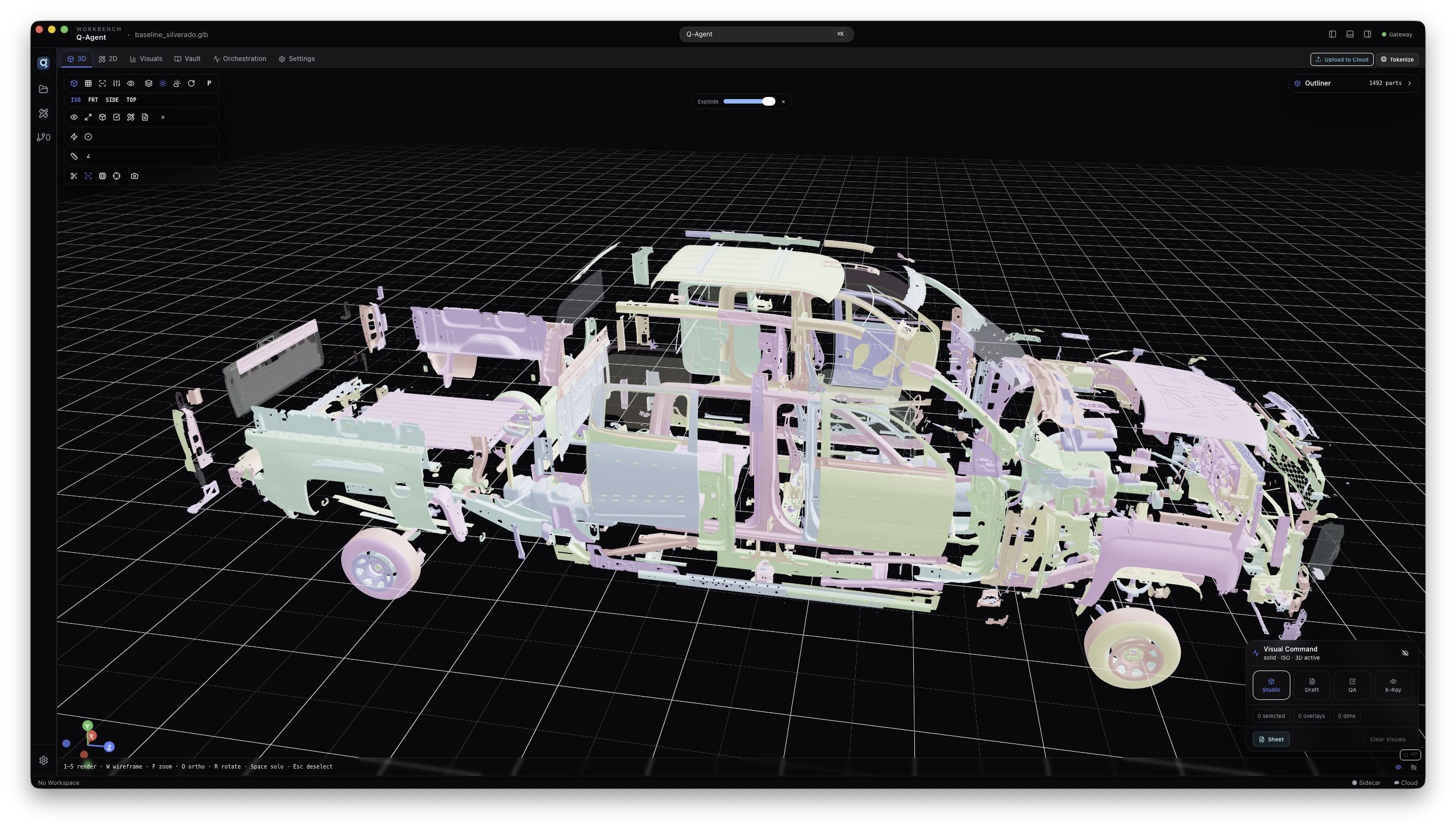
Engineering review is still trapped in tool handoffs
CAD, FEA, tolerance analysis, manufacturability checks, and compliance reviews often live in separate workflows. Every new question can mean another export, another mesh, another manual review, and another delay.
Hours to days of preprocessing, handoffs, screenshots, and manual engineering review.
Encode the assembly once. Run multiple design-review agents against the same spatial representation.
Encode once. Query repeatedly.
Quatrion compiles a CAD assembly into a compact spatial reasoning layer. Engineering agents can then inspect geometry, relationships, tolerances, surfaces, clearances, manufacturability risks, and spatial constraints without starting from scratch each time.
Spatial assembly encoding
Convert complex CAD assemblies into a reusable spatial representation for fast engineering queries.
Engineering agents
Run first-pass agents for tolerance, manufacturability, NVH, stamping, ergonomics, safety zones, and part consolidation.
Evidence and provenance
Return answers with geometry-linked evidence, replayable reasoning, and audit-friendly traces.
Why now
Engineering organizations are under pressure to shorten release cycles, reuse platforms across programs, and reduce expensive simulation bottlenecks. At the same time, AI agents, GPU compute, and geometry-aware representations are finally mature enough to make CAD-native reasoning workflows practical.
Benchmark figures from a representative 1,492-part automotive body assembly. Baselines, comparison conditions, and scope are detailed in the Benchmark notes below; final engineering validation is outside the benchmark scope.
Benchmark: one assembly, multiple agents
In a 1,492-part automotive body assembly benchmark, Quatrion encoded the assembly once into a compact query cache and ran multiple first-pass engineering agents against the same spatial representation.
Benchmark notes: Measured on a representative 1,492-part automotive body assembly. Compression compares source CAD artifact size to the generated query cache. GPU batch compute compares the benchmark GPU pipeline to a CPU baseline for equivalent feature-extraction tasks. Triage speed compares first-pass Quatrion agent runs to specialist-tool handoff workflows for the same review category. Final engineering validation remains outside the benchmark scope.
Quatrion references engineering standards for first-pass triage. It does not replace certified compliance testing, final validation, simulation sign-off, or engineer approval.
Design-review agents for real engineering workflows.
Grouped by the engineering decision they support — not by algorithm. Each group runs against the same encoded assembly, and your team can author more through the SDK without rebuilding the encoding, routing, or evidence layers.
Design review
Catch geometric and assembly-level issues before they reach a release gate.
- Tolerance verification
- Surface continuity
- Part consolidation
- Clearance checks
Simulation triage
Decide which parts and load cases deserve a full solver run first.
- NVH screening
- Buckling susceptibility
- Stamping / forming risk
- CoG migration
Ergonomics & safety
Screen occupant and operator interactions against standard envelopes early.
- Reach envelope
- Vision obstruction
- Head-impact zones
- Human access constraints
Reference agents demonstrated on the encoded benchmark assembly. They are the patterns your designers extend from via the SDK.
The Spatial Brain™. Three pieces of math, one substrate.
The Spatial Brain™ compiles a CAD assembly into a queryable structure before any solver touches it. The math below is the public face; schemas, encoders, and benchmarks stay IP-protected.
CAD becomes a compact geometry substrate.
Each part is encoded as integer-quantized position, orientation, and a shape descriptor. A 100–500 MB assembly collapses to a 1–5 MB cache that downstream agents and tools query directly — no re-meshing per question.
Shape behavior is captured as compact screening features.
For each surface, Quatrion computes geometry-derived screening features that help prioritize NVH, stiffness, and thermal-risk review before a full material-aware solver run. These features are intended for first-pass triage, not replacement of material-aware simulation.
Fit and tolerance risk is prioritized for review.
Mates, contacts, alignments, and clearance targets are organized into reviewable relationships so fit drift can be ranked by practical engineering impact. The goal is to surface systematic tolerance issues clearly, instead of asking an engineer to inspect thousands of part-pair distances.
And three pieces of authoring, that your designers own.
Reference agents on this page were authored against the same SDK your team will use. You define what the agent answers, what geometry it reads, and what evidence it returns — the workbench renders the rest.
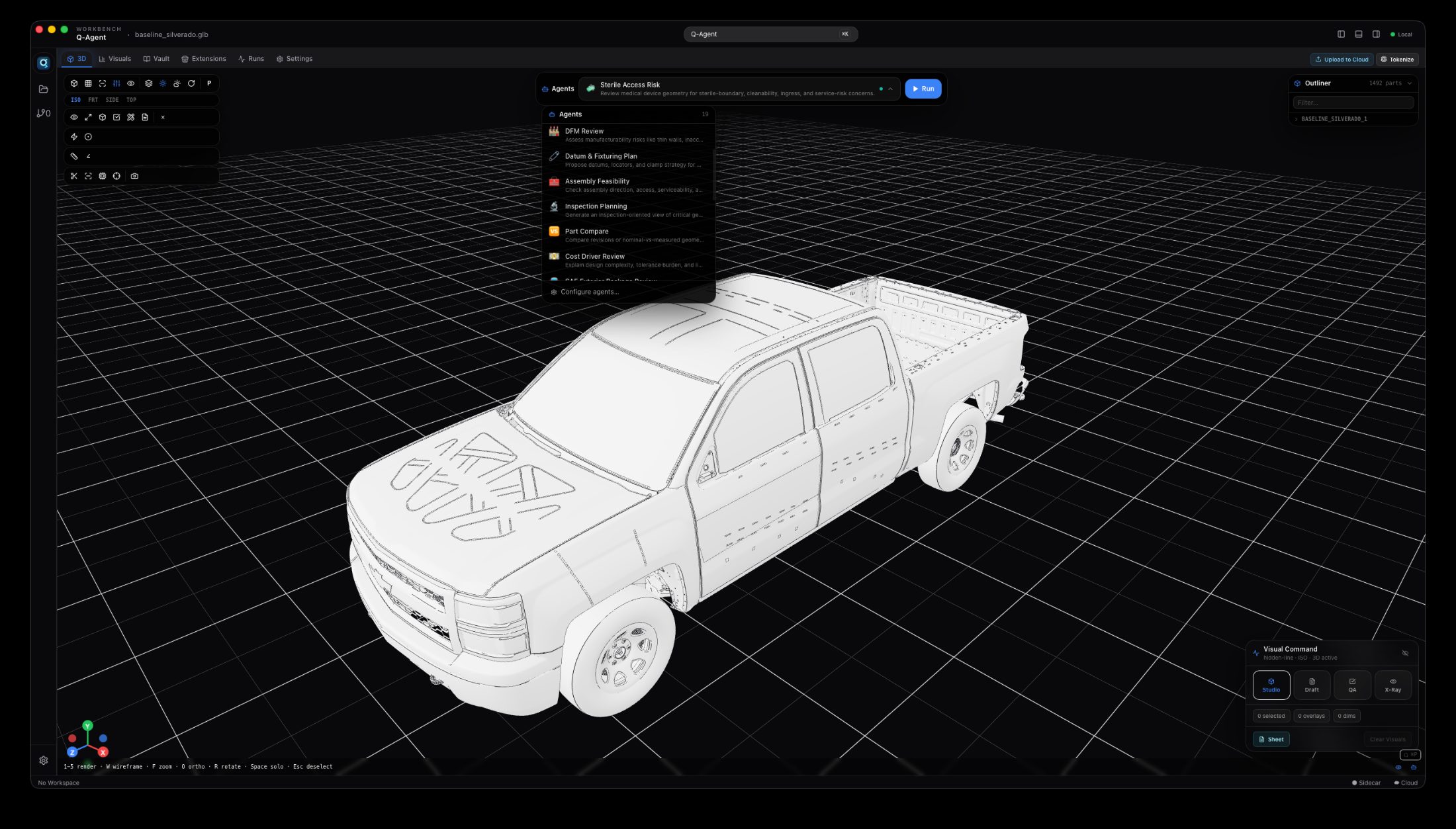
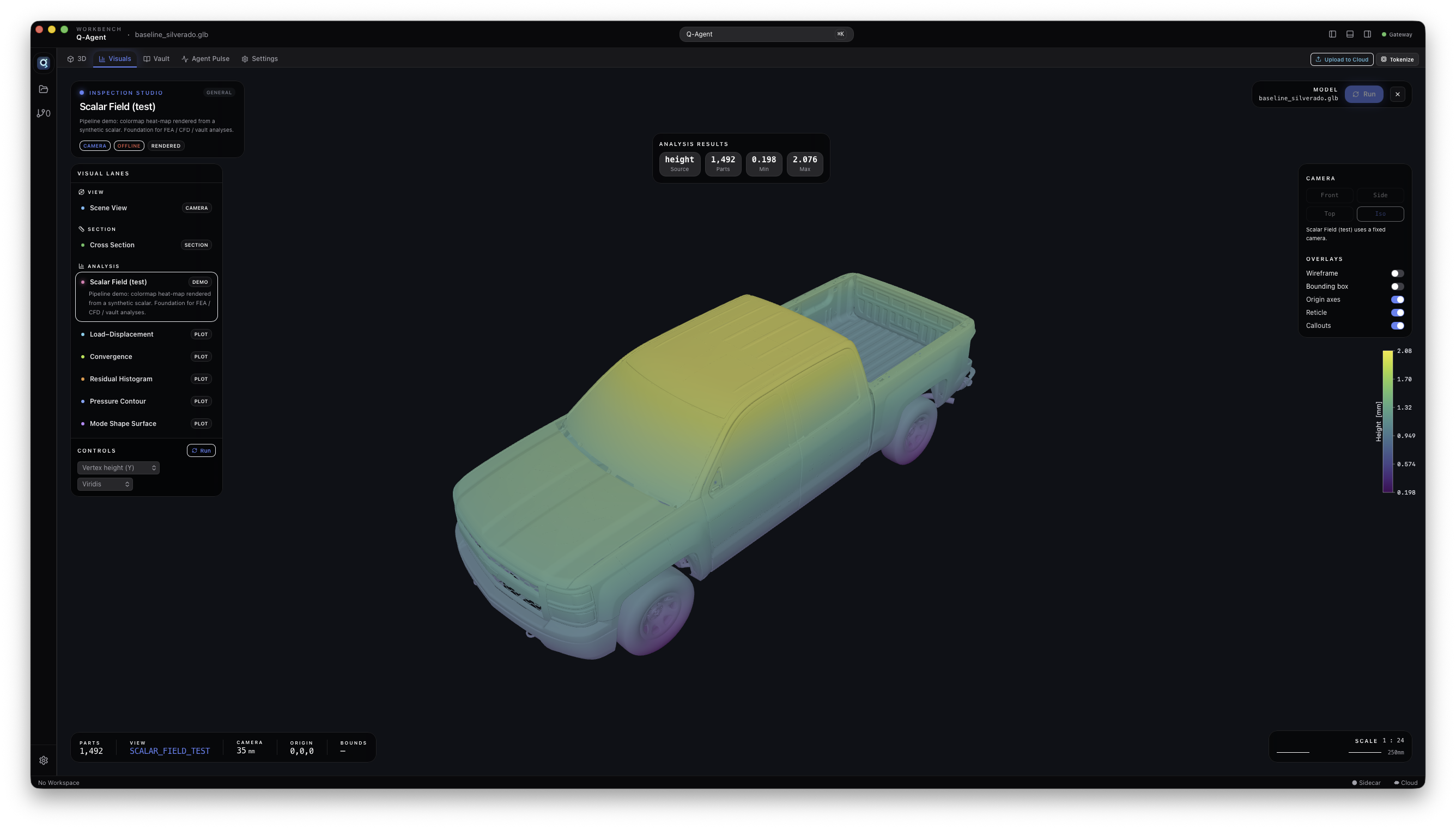
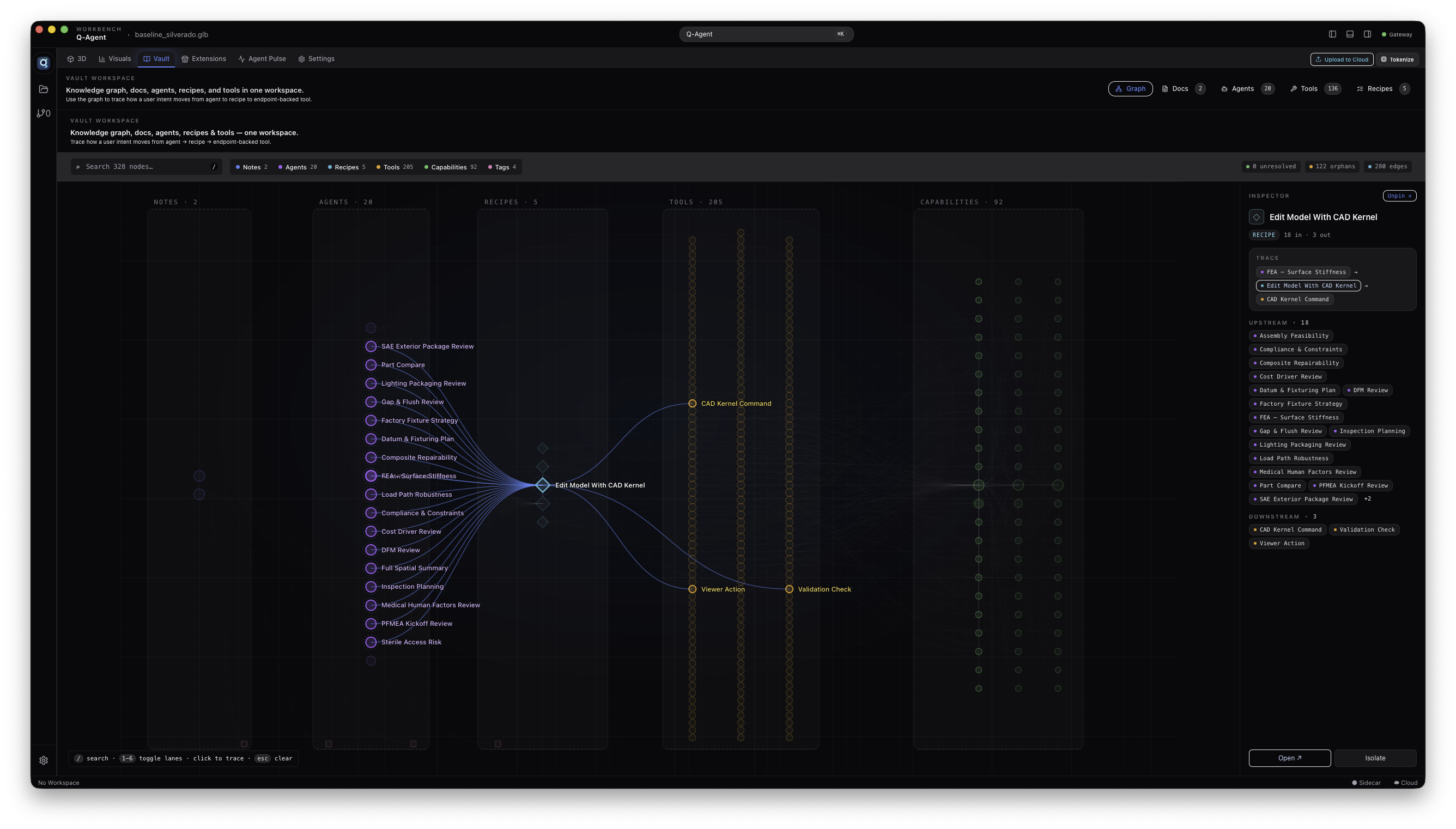
Four surfaces. One workbench.
The shell every agent renders into — and the deployment model that lets your team run it inside your network boundary, against your own files.
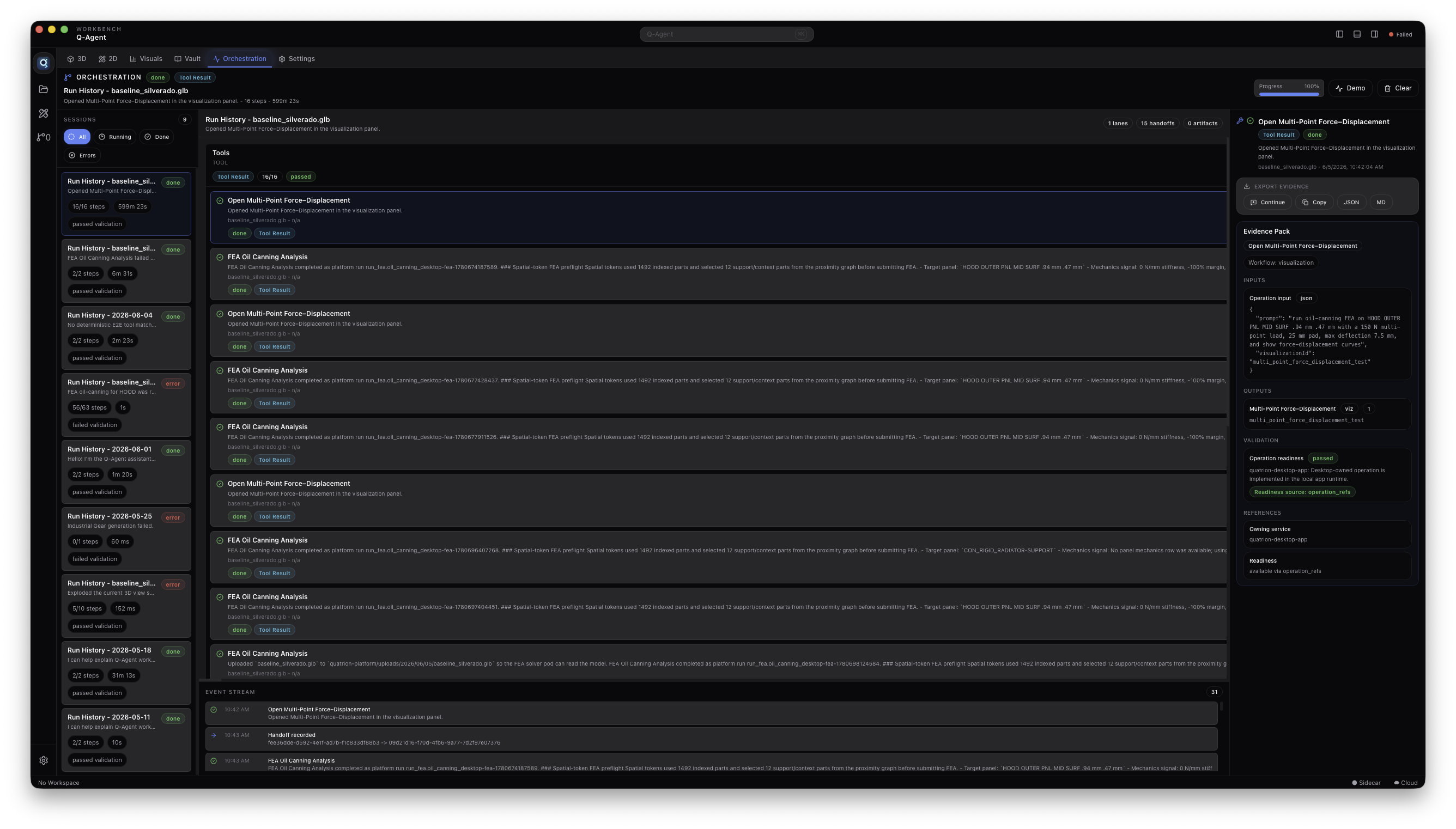
Cloud-agnostic by design. No managed-runtime lock-in.
A polyrepo of independently deployable services behind a single workbench. Storage, secrets, identity, and job state are abstracted; nothing on the critical path requires a specific cloud provider.
Between your CAD stack and the decisions that come out of it.
Quatrion does not replace CATIA, NX, SolidWorks, Ansys, Abaqus, PLM systems, or engineering judgment. It adds a geometry-aware reasoning layer that helps teams triage issues earlier, preserve evidence, and accelerate review workflows.
Your CAD & simulation stack
- CATIA · NX · Creo · SolidWorks · Onshape
- Ansys · Abaqus · Hyperworks · Star-CCM+
- JT · STEP · GLB · IGES · STL
- PLM systems of record
Spatial-reasoning substrate & agent platform
- Spatial Brain & CAD kernel
- Reference agents + agents your team authors
- Workbench shell · provenance · replay
- Cloud-agnostic, local-first option
Decisions, evidence, downstream handoff
- Design-review findings with provenance
- FEA prioritization & cycle triage
- Manufacturing & DFM signals
- Standards-referenced analysis runs
From flat drawings to an editable 3D solid.
Drop in front, side, and top views. Quatrion extracts the sketch geometry from each, reconciles them into one consistent shape, and proposes an editable 3D solid — with a replayable feature program and a bill of materials, not a frozen mesh.
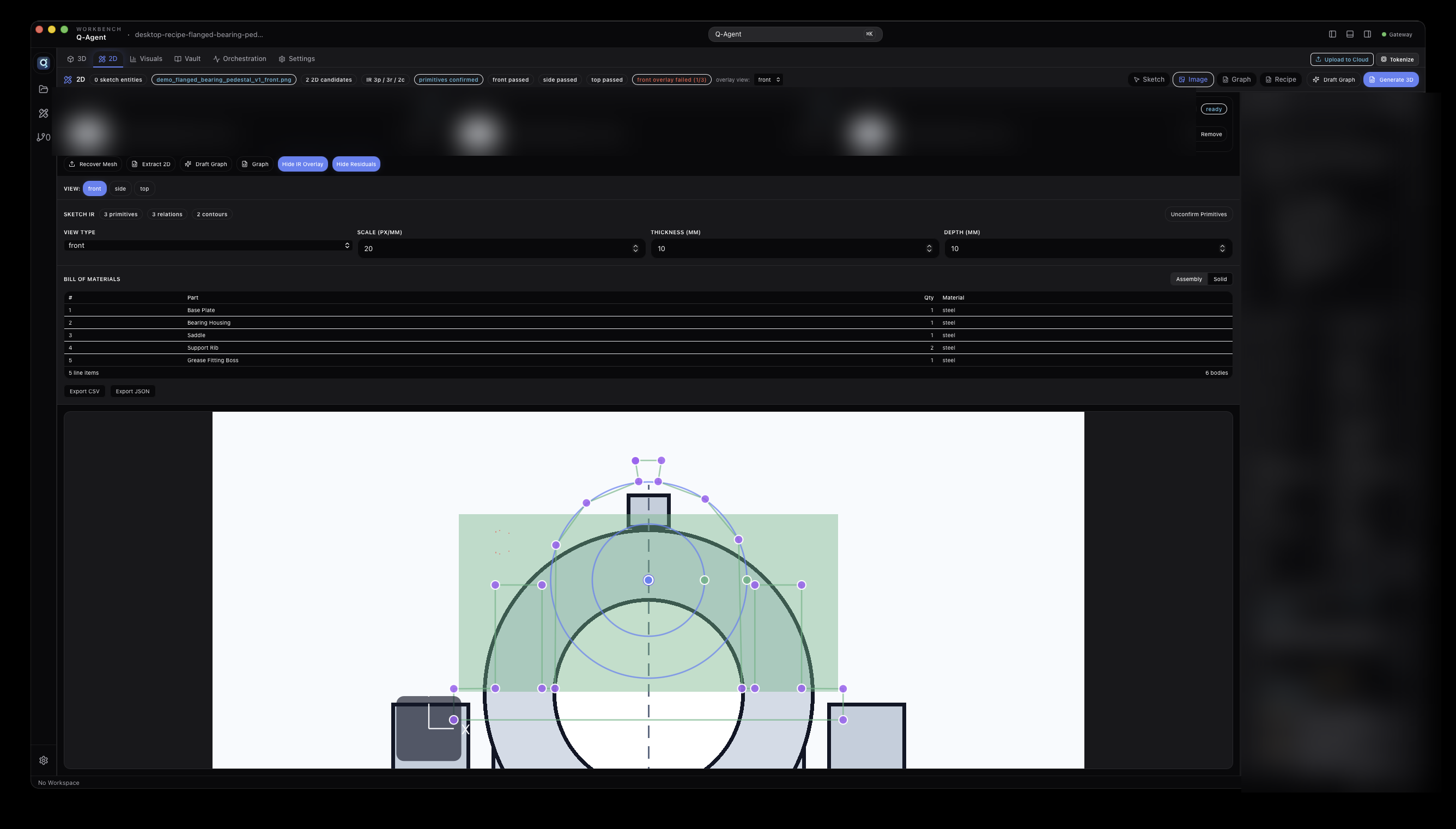
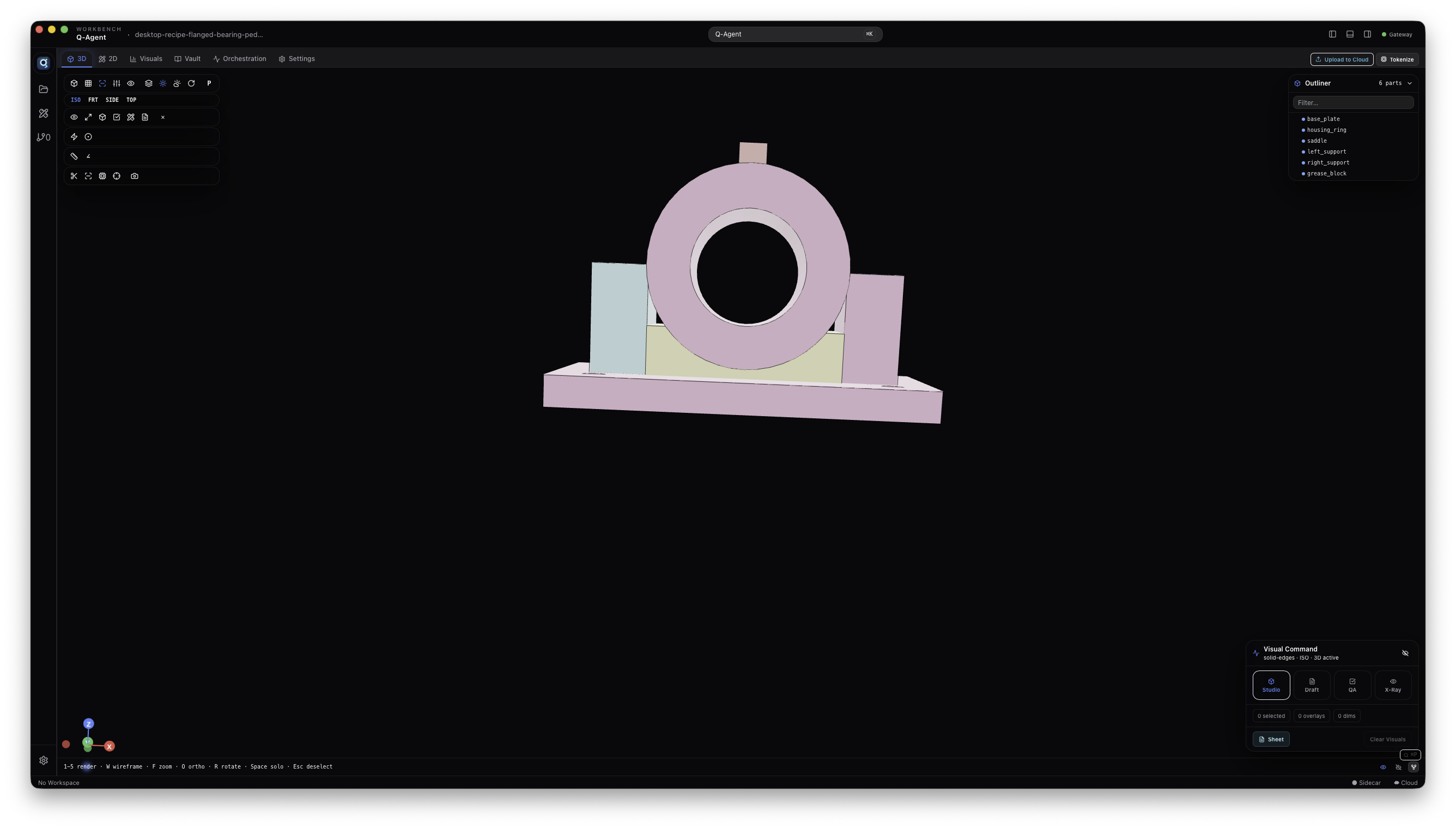
First-pass reconstruction for review. Engineers confirm and edit the result before release — the workbench shows its checks, assumptions, and any view mismatches instead of hiding them.
Read each view
Every drawing is interpreted into clean sketch geometry — profiles, holes, and relations — with a confidence signal attached to each view.
Reconcile across views
Front, side, and top are cross-checked so footprint and silhouette agree before any solid is built. Disagreements surface as warnings, not silent errors.
Emit an editable solid
The result is a single closed, manifold solid with a replayable feature program and a bill of materials — editable in the workbench, not a one-way export.
Built for engineering IP, not generic chatbots
Quatrion is designed for CAD-heavy organizations where geometry, product data, and engineering decisions are sensitive. Deploy locally, on workstations, on-prem, in private cloud, or on Kubernetes — while keeping reasoning evidence tied to the source geometry.
Local-first
Raw CAD can stay on the workstation; only configured queries cross the boundary.
Cloud-agnostic
The same charts deploy to AWS, GCP, Azure, or on-prem Kubernetes — provider is a config change.
Replayable reasoning
Every run is captured so it can be replayed, shared, or compared to a prior run.
Geometry-linked evidence
Findings point back at the specific geometry references behind them.
Engineering audit trail
Inputs, tool chain, and outputs are recorded as structural provenance.
The spatial AI layer for engineering teams
Generic AI can summarize documents and answer text questions. Engineering teams need systems that understand geometry, assemblies, constraints, tolerances, surfaces, clearances, and manufacturability context. Quatrion is building that spatial reasoning layer.
Built by engineering and infrastructure operators
Quatrion is being built by operators with experience across cloud infrastructure, data platforms, AI systems, manufacturing workflows, and enterprise engineering environments.
The company is focused on one clear wedge: helping CAD-heavy engineering teams run first-pass design-review agents over complex assemblies, with evidence tied back to geometry.
Bring one assembly. Run one agent. See the evidence.
Start with a CAD assembly and one high-value review workflow. Quatrion will show how spatial agents can accelerate first-pass engineering triage while preserving evidence and provenance.
We review every request and follow up with qualified teams. The form helps us scope the right starting agent and assembly for your engagement.
 Quatrion
A command-first desktop workbench for CAD-native engineering teams. Grounded answers from your own files, in your own environment.